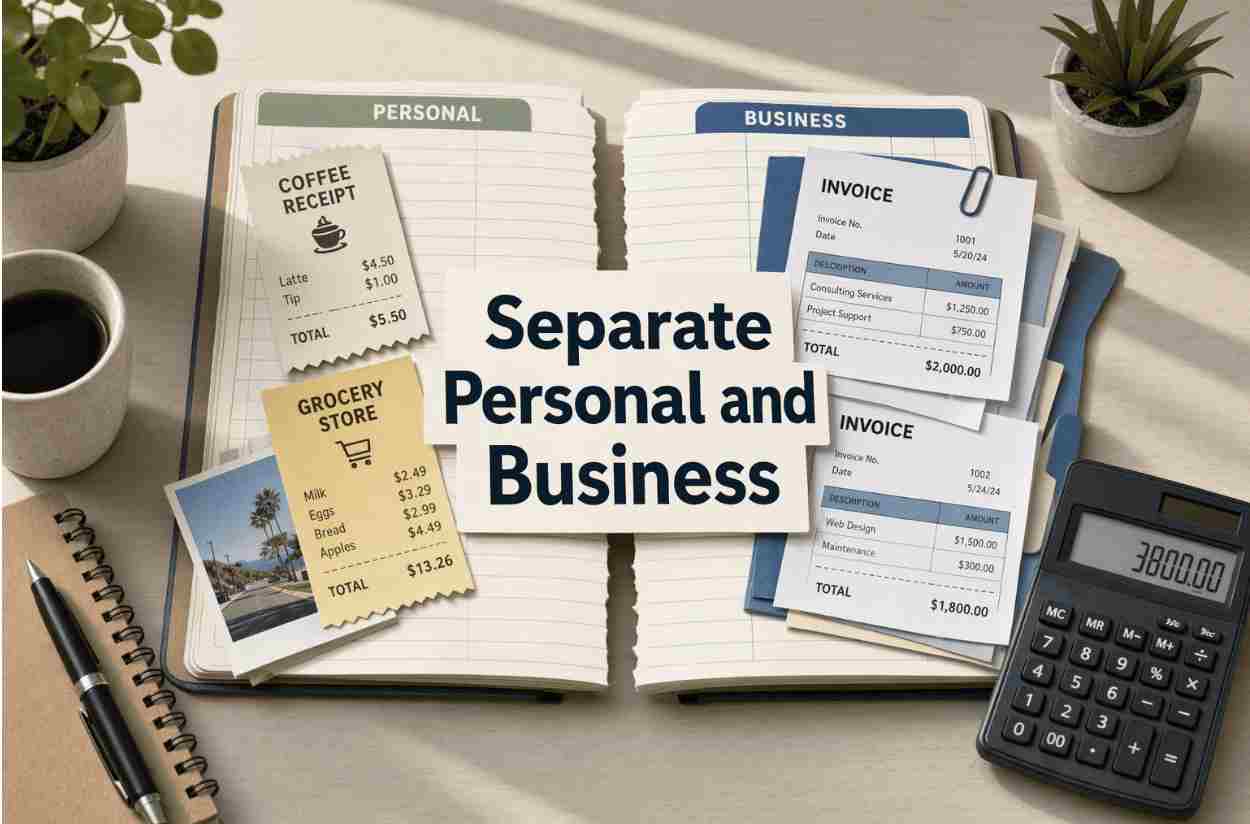
How to Stop Mixing Personal and Business Expenses: A Practical 6-Step Framework Introduction Your chartered accountant just called for the third time about reconciling your current account, and you realize half the entries are from the online grocery run you did last Tuesday. This is the cash-flow fog that builds silently when every coffee, software subscription, and client payment receipt floats through the same bank statement like indistinguishable debris. It is not a trivial filing headache; it is a financial risk that can inflate your taxable income artificially or trigger a tax notice that eats up months of your attention.
The core problem is what regulators call commingling of funds. In the eyes of the tax department, every personal payout sitting inside your business ledger looks suspicious. The US Internal Revenue Service is blunt about this: personal, living, or family expenses are generally not deductible , and money taken out for personal use must still be counted in your gross income first. Indian tax law takes an equally hard line, routinely disallowing any blurred spending under the Income Tax Act and reversing GST input tax credits that cannot be proven as strictly business-related. This framework gives you the structural fix. Across six concrete steps, you will lock down exactly where business cash lives, how to log it in real time, and how to stay compliant without living inside a spreadsheet.
Key Takeaways These six steps make a watertight separation between personal and business funds non-negotiable and simple to maintain.
Structural separation is the only durable fix: A dedicated business bank account and business credit card make commingling physically impossible before you ever touch a ledger.Real-time classification prevents backlog decay: Categorizing every transaction on the day it happens stops the pile-up that turns bookkeeping into a costly forensic exercise.Automation handles the drift: Cloud accounting software that auto-categorizes bank feeds cuts out the manual errors where personal spending leaks into business reports.Cross-boundary transfers need a strict protocol: Owner draws are equity movements, not business deductions; personal cash spent for business needs a disciplined reimbursement workflow with digital receipts.Indian GST and Income Tax compliance is unforgiving: Mixed expenses trigger ITC reversal under GST rules and outright disallowance under Section 37, making clean software-driven GSTR-1 and GSTR-3B filings your audit shield.Step 1: Open Dedicated Business Bank Accounts and Credit Cards A separate current account is not a nice-to-have for 'organized' entrepreneurs; it is the single structural lever that isolates your business cashflow from your personal life. Keeping separate business and personal accounts makes recordkeeping easier, and it also creates an immediate audit trail that shows every transaction had a deliberate business purpose. For a sole proprietor operating under their own PAN in India, this step eliminates the daily ambiguity of whether a UPI debit was for a client lunch or your weekend grocery run. Below are the core tools you need to put in place immediately.
Decision Factor Business Current Account Business Credit Card Primary Function Isolates all business income and outgoing payments into a single, verifiable ledger separate from personal cash. Segments all recurring and variable business spending onto a statement that never mixes with household expenses. Selection Criteria Choose a bank offering zero-minimum-balance business accounts with integrated GST filing support, such as the digital current accounts offered by major Indian private banks. Look for a card that rewards business spending categories (like software subscriptions or office supplies) and sends instant SMS or app alerts for every swipe. Sole Proprietor Edge Even under your individual PAN, a business-tagged account lets your accountant pull bank statements that are completely free of personal UPI transfers. Eliminates the 'was this card personal or business?' question during reconciliation, saving hours during tax season. Immediate Audit Benefit Statements are a complete, clean snapshot; you never have to manually redact personal entries before handing records to a tax auditor. You can pull an annual category-wise spend report directly from the card issuer's portal, which serves as a ready-made expense breakdown.
Step 2: Classify and Record All Transactions Correctly from Day One The moment you swipe a payment or tap your UPI app, you have roughly 30 seconds of perfect clarity on what that money just purchased. Use that window. Logging a transaction immediately at the point of sale stops uncategorized digital scraps from piling up. Those scraps are what turn month-end bookkeeping into a guessing game. Delaying this step creates exactly the backlog that forces you to mix categories out of fatigue, because sorting 300 transactions in a single sitting means you will simply shove ambiguous entries into the wrong bucket. Follow this sequence.
Apply the direct income nexus test: At the moment of payment, ask whether the purchase helps you earn the specific fee or revenue you are working on right now. A laptop for client work has a direct nexus; the family holiday flight, no matter how creative you felt on the beach, does not.Check the ordinary and necessary threshold: The IRS standard is useful here. The expense must be both ordinary (common in your trade) and necessary (helpful for your business); a graphic designer can justify stock image subscriptions, but not the new gaming console.Pick your category pre-payment, not post-statement: Decide the expense label in your head before the money leaves the account, and enter it into your digital cashbook or app as 'Cash out' under that precise category right then.Split dual-purpose items at the source: If you use your vehicle for both deliveries and family errands, log the portion of fuel that is for business as a separate entry the day you fill the tank, rather than trying to math it out from one blended figure months later. Expenses for items like a vehicle that serve both business and personal purposes must be divided between business and personal use.Tag every receipt digitally before it fades: Thermal paper receipts degrade into blank slips within weeks; photograph them with a tool like Swipe or your accounting app's camera feature and attach the image to the transaction record within the hour.Step 3: Implement a Bulletproof Invoicing and Payment Collection System A pristine business bank account means nothing if half your clients are depositing payments into the same savings account where your family deposits festival cash gifts. The separation architecture must extend all the way to your invoicing workflow. Set up a clean payment collection system with these steps:
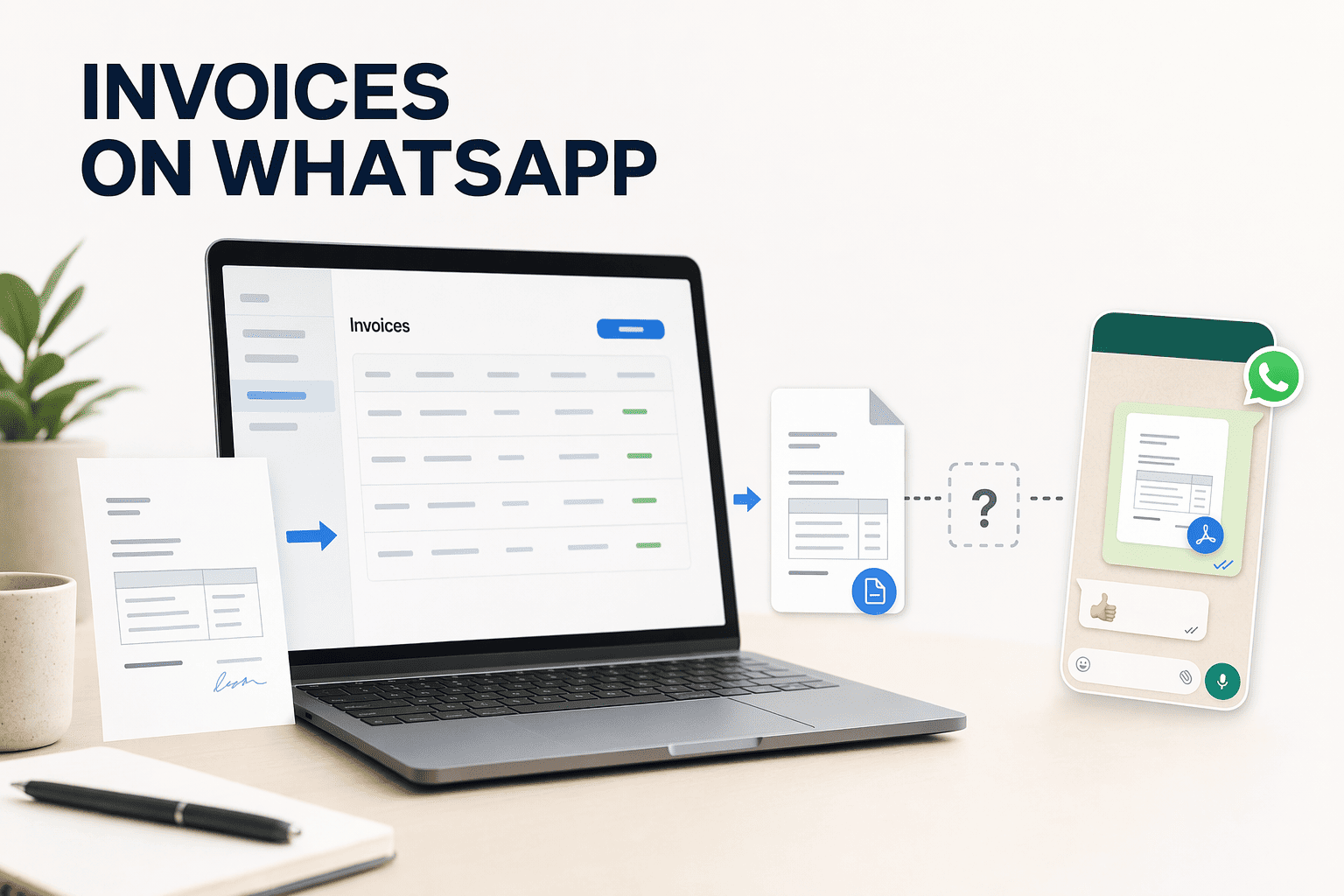
Dedicated billing details: Print your business bank details, and only those details, clearly on every invoice.Integrated payment tools: Use a tool like Swipe to generate invoices that embed your business UPI ID, QR code, or current account number directly on the bill, so customers have no excuse for sending money to your personal number.Immediate reconciliation: Once a payment hits your business account, immediately mark that invoice as paid and reconcile the deposit in your software's ledger.When automation links directly to ERP data, open invoices, bank statements, and payment details all line up more reliably. The goal is a self-enforcing system where business income lands in the business container by design and every deposit matches an issued invoice without a single manual spreadsheet hunt.
Step 4: Use Accounting Software to Automate Segregation and Reconciliation The gap between 'I tried to separate expenses' and 'my records are actually clean' is almost always filled with tedious manual categorization that a human will eventually botch. Cloud accounting software closes this gap by ingesting your bank feeds directly and applying rules that sort every transaction into the correct bucket without you touching a dropdown menu. SMEs reduce cash leakage by 71% using programmable wallet limits, duplicate invoice detection, and auto-categorization, a figure that highlights how much money simply evaporates through manual sloppiness. Instead of staring at a CSV file and guessing, you open your dashboard and see a clear split: cash in from business, cash out for business, and a separate tab for personal draws.
These systems work because they learn your patterns. When you tag a specific merchant as 'Software Subscription' twice, the software auto-fills it on the third occurrence and flags anything that does not match a known category for your review.
For the Indian context, software selection must go deeper than basic segregation. Tax platforms like ClearTax or dedicated digital cashbooks generate GST-compliant reports where mixed expenses are explicitly separated before they reach your GSTR-1 and GSTR-3B. You can set rules that automatically strip out any transaction tagged as personal from the input tax credit claim, eliminating the most common trigger for a GST department notice.
Standalone finance tools often create technical debt , with manual finance issues like delayed spreadsheets or posting errors spilling into IT departments as rollback requests and support tickets. Pick a tool that integrates with your existing workflow, not one that demands you build a new process around its limitations. The point is silent automation, not another platform you have to babysit.
Step 5: Handle Personal Draws and Reimbursements the Right Way No matter how disciplined you are, money will cross the boundary in both directions. You will take cash out of the business to pay yourself, and occasionally you will pull out your personal credit card to pay for a business subscription. The danger here lies in how you label these movements in your books. Follow these rules for cross-boundary transfers:
Label owner withdrawals correctly: When you move money from the business account to your personal pocket, label it as an owner's draw (for a sole proprietor or partnership) or salary payment (for a company). Never call it 'Office Expense' or 'Miscellaneous', this is one of the fastest routes to a tax notice in both India and the United States. In your accounting journal, these funds must hit your equity or drawings ledger, which stays separate from your profit and loss statement and has zero impact on your deductible expense calculation. The IRS framework reinforces this constantly: money used to pay personal expenses must be included in gross business income when the business earned it.Create reimbursement entries for personal purchases: When you buy a genuine business item with personal cash (e.g., grabbing a printer with your own UPI app), log the payment slip in a tool like Swipe, create a reimbursement entry immediately, transfer the exact amount from your business account to your personal account, and link the journal entries so an auditor can trace the full loop. Sloppy documentation of mixed-use assets creates a direct penalty risk in late-filing scenarios because disallowed amounts slip through the cracks.Treat each transfer with formal journal entries: Use a journal entry that reads 'Owner Draw' with a date and amount, paired with a reimbursement slip showing the matching business purpose. This keeps the structural wall intact even when money moves through it.Step 6: Ensure Compliance with Indian Tax Laws (Income Tax and GST) Indian tax compliance is built on a principle of strict separation, and the system punishes commingling with disallowance and reversal, not gentle nudges. Under the Income Tax Act, specifically Section 37, an expense that is not laid out wholly and exclusively for the purpose of the business can be struck down during assessment. Mixed expenses are the easiest target because you have already provided the assessing officer with the ambiguity they need. The penalty framework is not forgiving: as of the AY 2026-27 filing cycle, late and incorrect return filings attract penalties under Section 234F, and when a chunk of your claimed deductions gets disallowed, your tax liability can retroactively spike.
The GST layer amplifies this risk. Claiming input tax credit on a mixed expense, say a single phone bill that covers both client calls and family chatter, is a direct trigger. The Indian GST framework requires that credit is only taken on supplies used for business, and you must be able to map the tax component of a bill directly to a taxable outward supply. Submitting an unreconciled GSTR-3B that sweeps personal UPI payments into the business net creates an immediate exposure to ITC reversal, plus 18% interest, during an audit. Using accounting software like ClearTax or a digital cashbook purpose-built for Indian SMEs, which can instantly generate GSTR-1 and 30+ reports with personal expenses filtered out, converts a manual statutory minefield into a button click.
Your bookkeeping system must speak the tax department's language. Every report you pull should already isolate personal spending, so the figures that hit your ITR reflect only the deductions you can legally stand behind.
Conclusion You started with a physical bank wall and ended inside the statutory forms themselves.
Dedicated accounts, swipe-level classification, automated reconciliation, and classifying owner draws as equity flows produce a bookkeeping record that is auditor-ready. You avoid the monthly scramble where a single mixed transaction can trigger disallowance, penalty, and input tax credit reversal.
Implementing these six steps takes about a week. Most of that week goes toward printing updated account details on your invoices and connecting a bank-feed-enabled software tool.
Structural separation is a permanent fix. Once it is running, your only residual job is to let the automation hum.
Frequently Asked Questions What are the consequences of mixing personal and business expenses in my records? Mixing funds triggers tax disallowance and audit risk. Under the Indian Income Tax Act, personal expenses mixed into your profit-and-loss statement can be struck down under Section 37, spiking your taxable income. For GST, incorrectly claimed input tax credit on mixed personal supplies can lead to ITC reversal, 18% interest, and penalty notices on your GSTR-3B filings.
What steps can I take to separate personal and business expenses immediately? Take these immediate actions to establish proper financial separation:- Open a dedicated business current account and a business credit card today and route all future business transactions through them.- Photograph every receipt on your phone the moment you get it.- Install accounting software that auto-fetches your bank feed so you are never manually sorting a pile of unlabeled transactions at month-end.
Which bank accounts and financial tools are best for keeping business expenses separate in India? Set up a clean financial infrastructure with these steps:- Banking choice: Open a zero-balance digital business current account from Indian private banks that integrates with GST filing and UPI collection.- Credit card pairing: Pair this with a dedicated business credit card that sends instant spend alerts.- Software selection: Use a UPI-native tool or GST-compliant platform like ClearTax or Swipe to auto-categorize transactions and generate clean business-spend reports.
How do Indian tax laws treat mixed personal and business expenses, and what are the specific GSTR-1 or ITR implications? The Income Tax Act disallows any expense not exclusively for business, pulling it from your deductions and raising your net taxable income. On the GST front, claiming input tax credit on a bill that covers both personal and business use directly triggers ITC reversal risk in GSTR-3B filings, plus interest charges, making clean software-driven segregation your primary defense.
What is the difference between a business expense and a personal expense for a sole proprietor or freelancer? A business expense has a direct, ordinary, and necessary link to earning your income, such as project software, client travel, or a domain name. Personal expenses cover your private living costs: rent for your home, family groceries, weekend entertainment. Even if you work from home, the family's dinner bill remains a personal cost, not a business deduction.
How can invoicing or accounting software help prevent mixing personal and business transactions? Invoicing software like Swipe prints your business-only bank details on every bill, directing client payments into the correct account. Cloud accounting tools then import those bank feeds and automatically sort entries by your preset rules, flagging any personal UPI spends so they never accidentally land inside your GST reports or deductible expense ledger.




.png)
.png)
.png)
.png)
.png)